Friday, March 2, 2012

Agrigento

We arrived in Agrigento well after dark and were thus able to take in the full effect of the Valley of the Temples. The four main temples are brightly lit in a truly stunning display as you drive by on the highway near town. I’m not sure why it is referred to as a “valley” since all of the temples are actually located on a ridge that dominates the surrounding area (which is probably a valley of some sort!). Apparently, if you want to see the best preserved remnants of the ancient Greek world, your first choice might just be to bypass the instability of Greece and head to Sicily instead. These temples are one suggestion of why. The archeological site is another of the many UNESCO World Heritage sites which blanket Sicily.

It is hard to say that the temples are all original. Sicily is very geologically active and earthquakes, both major and minor, are common. As a result of all that rock’n and roll’n, most stuff eventually falls down. Across the years, the puzzle pieces are sometimes put back together and such restorations aren’t always recorded. Modern restorers take a different tack, making it very clear what was original and what has been redone.

All of which brings us to the temples themselves. On a craggy outcropping at the eastern end of the ridge stands the Temple of Hera Lacinia. All the attributions in this post are the conventional ones. There aren’t records and weren’t icons in the appropriate places to ever know for sure who any of the temples were dedicated to. It is a good sized temple, facing east as they all do, consisting of 6 x 13 columns.


As you walk west along the ridge you encounter a series of niche tombs, carved out of the rock, with a large olive tree nearby. Based on the size, the tree is estimated to be in excess of 500 years old. The tombs are much older.


Continuing west you come to the best preserved of the four temples which we saw, the Temple of Concordia. Concordia refers to the fact that is not attributed to any particular god, but rather to many. Built around 430 BC, it is nearly perfect in geometric proportions, being again 6 x 13 columns, each of which is exactly the same size and height. The ancient Greeks were big on physical perfection because they felt that it mirrored inner perfection and brought them closer to their gods. Its remarkable state of preservation is due to the fact that it was converted to a Christian basilica in 597 AD and thus maintained to some degree for many centuries beyond its contempories.


Next in line was the Temple of Herakles. As a temple dedicated to the mythical strongman of the ancient world who is also the national hero of Sicily and Agrigento, it was undoubtedly an imposing space. However, it is now reduced mostly to ruins. Of the original 38 columns (6 x 15) only 9 are standing today and even those were re-erected less than 100 years ago.


Finally we have the Temple of Olympian Zeus. Built to give thanks to Zeus for a victory over Carthage in 479 BC, it was HUGE. The building was over 110 meters long and 56 meters wide – in other words, larger than a football field, including end zones. It had 7 x 14 Doric-style columns, but that is a deceptive count since the space between columns was filled by a wall with 7 and 1/2 meter tall statues, called telamons, between them. Most of the building came down in 1401. A few of the telamons have been pieced back together lying on the ground and one is pictured below.


To give you a sense of scale, our friend Keith is pictured standing next to one of the column tops.


There are another 3-4 temples which are part of this group, but they are much harder to access and we did not venture to see them.

Thursday, March 1, 2012

Taormina

After spending a second night in base-camp Catania, we spent a transition day in Taormina. Catania is approximately midway between Siracusa and Messina which are located on two of the Sicilian points. We were ultimately headed toward base-camp Agrigento, midway between Siracusa and Palermo, which occupies the third point. If you gance at a map you will see that Taormina is actually going in the wrong direction which made for a very long day in the bus.

Our visit to Taormina more than made up for it. Taormina is a multi-layered city. It was settled by the Greeks, then taken by a long list of invaders and occupiers. Two of the most important for this post were the Romans and the Saracens. The moorish influence can be seen on the steeple of the church below. Captured in the background, high up on the summit of the hill, is the remains of a Saracen castle.


The picture below gives you a better perspective of the ruins. To the left of the main peak, on a shoulder of the mountain, is a church. The pathway to the castle takes you past the stations of the cross on your way to the church and then switches back to bring you the rest of the way up. Amy and I climbed there when we last visited in 1996, but there wasn't enough time to make a go of it this time.


The spectacular natural setting was undoubtedly one of the draws for the original Greek settlers. Mount Etna dominates the view to the west. During our current visit the summit of the volcano was shrouded in clouds.


The view of Etna provides a striking backdrop for the Greek theater carved into the mountainside above and to the east of the town. If it seems like we were seeing a lot of Greek theaters, keep watching, because we aren't done yet.


Evidence of the Roman remodeling of the theater is clearly visible in the pereformance area. They sought to make a site for spectacles by surrounding the stage with walls and filling in the background area with a brick and concrete, columned structure which, thankfully, is partially gone now so that the wonderful view of Etna can be enjoyed by visitors.


What had been a sunny day turned cloudy and then the showers came as we were making our way out of the town. This resulted in a beautiful rainbow display. The natives seemed completely unimpressed when we pointed it out to them, so perhaps it is a frequent occurence.


As we were driving away in the bus we were treated to the even more unusual display of a double rainbow. It is most easily seen in the picture below to the left of the primary arc. The bottom ends of the rainbows are basically symmetric with respect to the center of the picture. If you have never seen a double rainbow before, one of the ways you can identify the second rainbow is that the colors run backwards, from red to violet as you go from inside to outside the arc.

Wednesday, February 29, 2012

Noto

Noto Antica was an important city during ancient times. At its height, during the Arabic period, it was actually the capital city of one of the three administrative districts of Sicily. Then, in 1693, tragedy struck as the entire city was destroyed by a significant earthquake which also killed 1000’s of its inhabitants. Faced with the choice of rebuilding what was essentially a massive graveyard, the few remaining residents relocated to the current city of Noto some 8 km (5 miles) to the south. The resulting, planned city is listed as a UNESCO World Heritage site as one of the finest existing examples of the Sicilian Baroque style. I’m not a huge fan of baroque. In fact, I’m fond of saying, “If it’s Baroque, you should fix it”. But, seeing all of the buildings together is quite impressive.

The main administrative building is directly across from the duomo on the main street through town.

Looking uphill along a side street.


Once feature of this style is balconies such as the ones shown on the buildings lining the main street.


Many balconies are supported by interesting and intricate figures such as the grotesque faces in the picture below.


A fountain in a small piazza off the main drag.


Finally, we have Amy, gelato in hand, in front of the duomo. Sicily is renowned for its gelato and the weather was pleasant enough during our travels for gelato to be consumed. Then again, even if the weather isn’t great, Amy and I have been known to enthusiastically dig into a cone or cup.

Tuesday, February 28, 2012

Ortygia

The oldest part of the city of Siracusa is Ortygia, a small island connected to the mainland by three bridges. The maze of narrow streets makes navigation interesting. The only redeeming feature in that respect is that if you walk long enough you will get to the water and can find your way from there. It is an island, after all.


While we visited we took in two main attractions. The first is the duomo. The building was originally a 5th century BC, 6 x 14 column Greek temple dedicated to Athena. Notice, I didn’t say the duomo was built on the site of the temple. That is because the 7th century AD church was constructed by filling in the spaces between the columns to create an edifice in the Christian style. The entrance façade was rebuilt in the 18th century in the Baroque style. The remains of the columns and their Doric tops can be easily seen on the exterior of the building. Unfortunately, the cathedral was closed during our visit so we could not view the interior.


Our second stop was at the Fontana Arethusa, a natural fresh water pool where legend has it the nymph Arethusa took refuge when she was being pursued by Alpheus. It is not a fountain in the traditional sense with water gushing from a stone and concrete monolith. Rather, it is the opening where an underground spring/river surfaces. The pool, formed by manmade walls, is directly adjacent to the sea and empties into it, forming an estuary-like environment complete with a large stand of papyrus (reputed to be the northernmost papyrus) and a cotillion of ducks. The original inhabitants believed that the water flowed underground all the way from Greece. I’m not sure how they would have determined that, perhaps a message in a bottle dropped down a specific well in the motherland. While the water was originally pure and fresh, seismic activity at some point created a connection with salt water so that now the water which issues forth is somewhat brackish.

Monday, February 27, 2012

Siracusa

Sicily is basically triangular. The ancient city of Siracusa lies very near the southernmost vertex at the intersection of many important trade routes across the Mediterranean Sea. Siracusa, like all of Sicily, has seen many different rulers. If there was a group that came to Sicily then they either took control of Siracusa or at least tried to. Siracusa was founded by the Corinthians and some of the earliest remaining remnants are from that Greek period.

The archeological area includes a large altar platform and the remains of a Greek theater.


Above the theater a small waterfall cascades out of the opening formed by an ancient aqueduct.


I always find it fascinating when I come upon ancient wheel ruts carved out of stone. The ones seen below are easily a foot deep. So deep, in fact, that it might have even caused trouble for carts with lower axles. Imagine how many carts it would take rolling aver the ground to cut that kind of path through the stone.


Siracusa was involved in many conflicts, choosing allies one moment and switching allegiances whenever it benefitted them. Following one major battle against Athens, thousands of Athenian prisoners were held in awful conditions in an old quarry next to the ancient sites. One famous place within the quarry is called the Orecchio di Dionisio or Ear of Dionysius. The acoustics within the chamber are so good that legend has it the captors spied on their prisoners by listening at an opening high up in the vault. To put things in perspective, the opening to the cave shown below is easily 50 feet high.


The Greeks were not the only group to leave their mark on the city. Nearby the Greek theater are the ruins of a small Roman amphitheater. It is nowhere near as well preserved as the Colosseum in Rome, but at least nobody built over the top of it in modern times so you can see the entire outline. I was disappointed to note that you can no longer wander down into the main part of the ruins as you could when Amy and I first visited Sicily in 1996.


Sunday, February 26, 2012

Pupi

While pronounced the same way as what babies do in their diapers, pupi are actually marionette-like puppets. The art of making and using these puppets used to be a widespread art-form throughout the region of Sicily near Catania, but it is now dying. Only a few people continue the traditional way of producing and using the puppets. We spent our evening outside Catania in Acireale at the Opera dei Pupi Turi Grasso. All of the puppets are built by Turi Grasso, the pupi master, and costumed by his wife. The master himself narrated the action while two of his sons and a third person manipulated the puppets. Other family members are included in the business, but were not present for our visit.


After a brief introduction to the art of puppet making we saw a production of the Legend of Roland. The historical figure Roland was a general under Charlemagne who died defending the rearguard against the Basques at the Battle of Roncesvalles. The legend is something else which involved lots of manipulation, backstabbing and fighting scenes. Stomping noises from wooden blocks attached to the puppeteer’s feet provided the sound effects as swords clashed against shields and puppets hurled themselves against each other from opposite sides of the stage. There were some nifty special effects including one puppet whose head split in two and a bloody eruption from the throat of another. The show lasted over an hour with a brief intermission so that they could pick up all the slain puppets in preparation for the final death scene.  Interestingly, only one puppet in the entire production was female, Angelica. For better or worse, the entire evening was done in Italian so I didn't get as much out of it as I might have otherwise.

Saturday, February 25, 2012

Catania

Our first stop in Catania was the Centro Storico, or old center. There we found an inviting main square, complete with obligatory fountain and church dedicated to the patron saint of the city. We also found SUN! Below are pictures of the duomo and fountain in the main square.


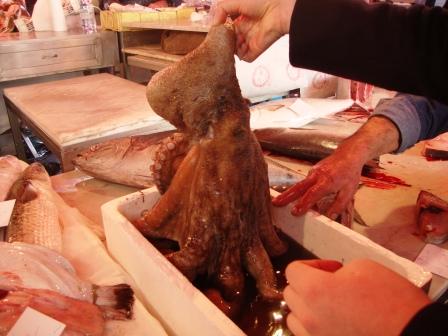
Lunch was a wonderful experience. A group of us headed into the local fish market, pooled our resources and selected a variety of goods from among the offerings. In truth, the stores around the edge made it more than just a fish market. Fresh fruit, cheese, sausage, etc. made for a delicious repast. There was a huge variety of fishy things available: Squid, swordfish, a live octopus and insect-like crawly things were all spotted along the way.


If you didn’t want fish, how about half a goat – cut laterally right down the middle. Ummm, yummy brains.


There was also a purple cauliflower thing which we were told was really tasty, but we didn’t have any on the trip and carrying one home wasn’t really a viable option.


Finally, we headed a quarter mile down the road to the first of what would be MANY ruins, in this case the remains of a Roman era amphitheater.