Thursday, December 15, 2011

Trulli of Alberobello

If there was a theme to our recent southern journey it would probably be the interesting housing we encountered. Alberobello is famous for stone houses, unique to the region of Puglia, called trulli. They dot the countryside around the town, singly and in small clusters, until you arrive at the historical center to discover hillsides covered with hundreds of them. The original trulli were made without mortar. The hypothesis being that when the tax man came, given enough warning, the house could be reduced to an untaxable pile of rubble and then susequently reconstructed. It seems like a lot of trouble to go through since building one of these places would involve days, weeks and perhaps even months to complete. As we walked about the town, many of the trulli we encountered were very old, but they all have a sense of permanance. The exterior walls are mortared and the insides are finished surfaces. While the roof seems to continue to be constructed of unmortared stone, there is often a cap at the peak which is permanantly fixed in place. The typical trulli roof has a certain conical symmetry, even if it is placed on a quadrilateral building. The picture below is of a "trulli out standing in a field".


There are two concentrations of tulli in Alberobello. The western hill is shown below. A large fraction of the tulli there are either shops or can be rented out by the night, week, or longer. Yes, you can sleep in a trullo if your heart truly desires it.


The trulli on the eastern hill are mostly privately owned. There is a small public park/belvedere on the eastern side from which one can view the western side. The eastern area is behind Amy.


The largest trullo in town is called Trullo Sovrano. It isn't actually all that old, having been initially built in the late 1700's. It was built for the parish priest of the church it is directly behind. What is cool about it is that it is the only double decker trullo in existance. There is conclusive evidence that the building was not built all at once but expanded organically over time. The roof is not one single cone but instead, is a group of melded cones.


Originally, you could walk around on the roof of the trullo as the stairs in the picture below suggest. Windows on the stairway to the second floor reveal small rooftop terraces and walkways. However, the stairs to the top are now blocked and it is clear they don't encourage visitors.


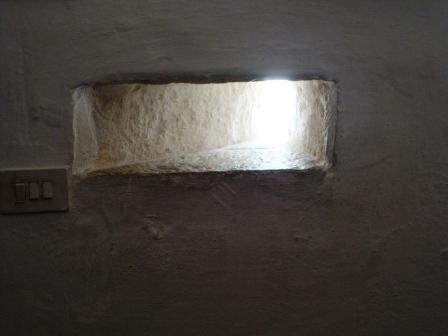
A nifty feature of Trullo Sovrano was this hole in the bedroom wall to the left of the main entrance. It served the dual function of allowing the owner to see who was at their door and, as the shape suggests, to greet them with a gun if they weren't welcome.


The trulli of Alberobello and the Trullo Sovrano are on the UNESCO World Heritage list. A visit, if you happen to be in the area, is well worth the drive.

Wednesday, December 14, 2011

Matera

We spent three nights in Matera over the weekend and used it as our locus of activity. I have posted about our hotel in the caves; here are some observations about the rest of the town. The Sassi is an incredible maze of twisted, narrow alleys and winding stairways. There is only one driveable road which loops through the cave dwellings and even that is an adventure. With the exception of a couple of lots which are always packed, parking is done by pulling as far onto the sidewalk as you can and then ignoring your vehicle. Getting lost, even with a reasonably detailed map, is a given. Once you exit the Sassi, you are in a modern city. In the Piazza Pascoli and along the Via Ridola we encountered a sprawling Chirstmas market. There were only a few stalls, but they were more to my liking than the ones in Viterbo. We munched on some fantastic local cheese and had a nice discussion with a local winemaker. He brought out the good stuff for us and we enjoyed it enough to bring home a bottle of the local "Primitivo", a variety related to zinfandel, and a rosato (rose). The main gathering point for the city is the Piazza Vittorio Veneto. They have excavated some of the old ruins under the square as a museum and have a nice fountain which was all lit up in green and red for Christmas.


Near the Piazza di San Francesco is the Chiesa Purgatorio whose doors are decorated in an interesting skull and bones motif.


This is a skull and hourglass post standing beside the main door which we found interesting.


We were somewhat dismayed to discover that dinner time in Matera begins at 8 PM and even then they look at you sort of funny but tolerate you anyway when you show up to eat. Dinner really isn't at 8, that is just when the restaurants open. They take their time getting around to you. However, our hunger was marginally diffused by the magnificent passeggiata which took place on the Corso and along the edge of the Sassi. The passeggiata is the evening walk. There were hundreds of people out in the street. Families, children, couples all just taking in the evening, meeting their neighbors and enjoying life. This passaggiata takes place everywhere in Italy including, to a lesser extent, Viterbo. However, our main walk is down in the center of town and Amy and I seldom go.

Matera is situated at the edge of a gorge. The cave dwellings take advantage of this natural setting. Across from the town there are additional dwellings and a series of cave churches which can be visited. These rocky cliffs were the location for filming portions of Mel Gibson's The Passion of the Christ. The locals would love it if you would pay them for a guided tour but, having a car and a map, we set out on our own to explore. The belvedere (viewpoint) at the edge of the cliffs gave a remarkable perspective on Matera. Directly in the middle of this picture is our hotel. Our room was around to the left and up a short flight of stairs, all of which can be easily seen, but not when the picture has been compressed to put on the webpage.


To the left of our hotel is the beginning of a large stretch of abandoned caves. It is my understanding that the Italian government took it all over when they moved out the cave dwellers decades ago and now owns all of it. Our hotel has a 30 year lease from them with an option for 30 more years after that. At the top of the picture you can see the beginning of the modern town which directly abuts the Sassi.


Of course, every once in awhile I need to put on a picture to show that we really were there!

Monday, December 12, 2011

Caves of Matera

Thursday, November 8, was the Immacolata or Festival of the Immaculate Conception. This is essentially a national holiday. There were no classes and few shops and restaurants were open. Italians traditionally use this day to decorate their Christmas tree. Since the holiday fell this year on a Thursday, the director of the school decided to extend the break by cancelling classes on Friday as well, giving the students time to be with their host families and/or to travel independently. Amy and I along with our traveling companions, Keith and Carolyn, took the opportunity to travel for a 4-day, 3-night stay in Matera, located on the "instep" of the Italian boot in the Basilicata region, some 6 - 6.5 hour drive from Viterbo.

Matera has been inhabited for thousands of years. People have been dwelling there in caves since long before the Romans, Greeks, etc. Matera is famous for its cave dwellings, or perhaps infamous would be a better description. The abject poverty of this region was referred to as the "shame of Italy" (vergogna d'Italia). Even as recently as the mid to late 1960's, families of 8-10 were living in single room caves with their animals with no electricity or running water. Malaria was rampant and the infant mortality rate stood at more than 50%. Beginning in the mid-1950's, the Italian government undertook the more than decade-long project of moving people out of the caves and into more acceptable housing. Ironically, since poverty led to them being passed over for development, the caves are now a source of fascination and a tourist draw to the town. The Sassi or "rocks of Matera" have been recognized as a UNESCO World Heritage Site.

We stayed in a boutique hotel called Hotel Basiliani created from some of the cave dwellings. The construction of such a dwelling was interesting. The rock in the area is tufa, a variety of limestone, which is very soft and can actually be easily cut and worked with when first removed from the ground. It hardens over time when exposed to air. Thus, the caves did not need to be naturally occuring dwellings, although they might have started that way. Instead, they were dug out of the mountain. The dug material could be fashioned into blocks and used to build walls within the cave or, if there was level space available in front of the cave, exterior walls could be built to expand the "cave" without needing to dig as far into the side of the mountain.

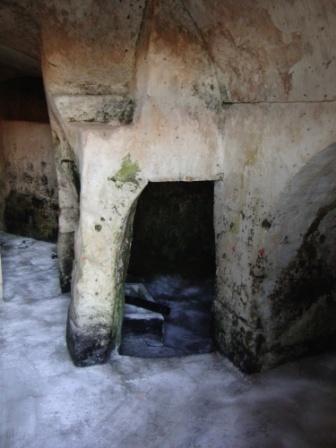
The interior of one of the "raw" caves is pictures below. The white powder is some sort of chemical used to help with pest/insect control now that the caves stand empty.


Visitors can explore a typical cave dwelling which has been recreated in collaboration with the family that actually lived there. Below are pictures of the kitchen alcove and main room of the cave. While you get a sense of the space constraints and living conditions, I don't think one can ever fully appreciate what it must have been like living in an unlighted, unheated cave with a bunch of farm animals (and their manure).


That brings us to our hotel. Each room is different as it uses the existing rooms of the varous cave dwellings in a perfectly located spot at the edge of the cliffs. You don't get any sense at all of living in a cave since it has been completely redone with all the modern conveniences. The floors have been leveled and there is the electricity and plumbing you would expect in a luxury hotel. There was even free, high-speed WiFi! The main room was so large, we could have danced the tango in it. Below is the sleeping area, which is a small part of the main area.


Next is the wardrobe area, down a few steps from the main room.


The bathroom, complete with toilet, bidet and shower/bathtub (not shown to right of picture) was off the wardrobe area.


There was one reminder of the original space. A glass covered opening allowed us to look down into the very large cistern below the dwelling which would have been used to hold rain water collected through a series of specialized drains and channels from the mountain above.


We would HIGHLY recommend this experience to anyone who finds it intriguing. More of our adventures and the cities/towns we visited to follow over then next few postings.

Thursday, December 8, 2011

Garden

One of the more unusual aspects of our apartment is that it looks out over an overgrown green space full of plants and trees. I mentioned it in passing several times and posted earlier pictures as the colors started to change. Unfortunately, we have no access to it and, in fact, our landlord doesn't even know who owns it. Last week I was startled to hear the sound of chainsaws buzzing nearby. After a short search I determined that it was coming from the enclosed garden space. It took three men working steadily for an entire day to clear out all of the underbrush and junk trees, leaving a beautiful open space filled with fruit trees and some grape vines. We were delighted, to say the least.

Until the next day.

When they came back and took out most of the remaining trees! It seems that the tenants in the building which actually owned and had access to the space were complaining about the shade it created and so they basically leveled the place. That is awkward, to say the least, since nobody lives on the ground floor of any of these buildings. Indeed, now that it is totally cleared out it is obvious that there aren't even any windows except basement casement windows. People, if you are in the basement you don't expect much light to come into the 1 foot by 3 foot window sitting on the ground. The remaining trees have been cut back to within an inch of their life. We just hope they are allowed to attempt to come back next spring rather than being chopped down the rest of the way. There is a nice magnolia, a cachi, several pear trees and what appears to be a citrus tree.


Perhaps the most disappointing part is that now we have a beautiful view of ... a parking lot. Can't wait until next spring when mother nature works her magic and heals the space.

Monday, December 5, 2011

Christmas Fair

Viterbo has a weekly, Saturday market set up in the main parking lot in the center of town near the Valley Faul. The parking area is part of the open space within the walls created decades ago by WWII bombing. There you can get inexpensive and cheap clothing, linens, cosmetics, etc. It isn't a flea market. Most of the goods sold are new. The vendors have a permanent, transient business, if that makes sense. They sell goods out of their trucks in similar markets all over the region and rotate from city to city on a regular schedule which gives them full-time employment without the hassle of a brick-and-mortar store.

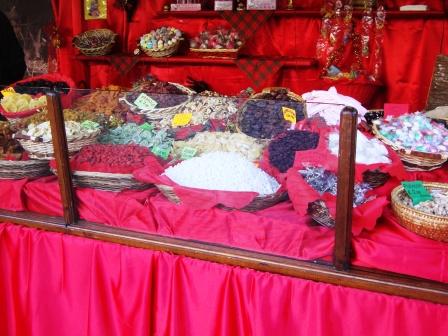
Into this mix we throw the Christmas fair or market. Christmas fairs are common throughout Italy and Europe in general. They spring up everywhere. Christmas fairs in some locations, such as Prague, are actual tourist destinations. There is no agreed upon beginning or ending date although most start in late November and run until the weekend before Christmas. Some, such as the fair I described in Ferrara, are a delight. Others, such as the one in Viterbo, (unfortunately) not so much. Rather than being truck based, the Christmas fair stores tend to be slightly more permanent structures. Often these take the form of tents with raised platform floors and plywood display structures rather than tables with bins. The tent city in Viterbo has green tops with vertical red and white candy stripe sides. Four pictures of the Viterbo fair are shown below


I guess the part that disappoints me most is rooted in my own expectations. When I think of a Christmas fair I think of handmade crafts, gifts and food. The fair in Viterbo is just more of the same stuff you can find in the weekly sale in more permanent structures with (maybe) a slightly more festive twist. In other words, while trying not to be too disparaging, it is a crapatorium. I can see the basic appeal, but I don't feel any driving compulsion to visit Viterbo's Christmas fair again.

Sunday, December 4, 2011

Roma

On Friday the school took the first of many day-long field trips to Rome. One of the things which attracted us to living in Viterbo was the proximity to Rome. At roughly 50 miles, straight down the Via Cassia, we figured that going there would be a regular and routine occurance. Then a funny thing happened on the way to the forum. We arrived in Viterbo and discovered we REALLY liked being here. Add to that the fact that you can't get there from here except by slow boat to China and we just never went back. This was literally our first trip to Rome since we brushed the edge of it on our train ride from the airport to Viterbo almost 16 weeks ago. In truth, it is easy and inexpensive. Trains run at least every hour and the cost for a day long transit pass is just 9 euros which includes round trip from Viterbo plus all your subway, bus and tram rides once you are in Rome. The kicker is that the main train ride is almost 2 hours long by itself and then you are left far away from the historic center needing to catch a subway train just to get anywhere close to where you want to be. It is an unfortunate fact that the subway in Rome is not extensive. Every time they try to dig a new tunnel they run into priceless archeology buried deep underground. That makes it difficult to ram a system around the city.

The weather was great, yet again. There was a little rain as we rode the train in, but it stopped in time for our arrival and most of the day was spent under partly cloudy skies with temperatures in the mid-60's. We arrived at Valle Aurelia and took the subway from there.


Our trip this time focused on two of the four museums which are part of the National Acheological Museums of Rome. Both sites focused primarily on sculpture recovered from all over Italy. The pieces are almost always ancient Roman copies of Greek originals. Wealthy and infuential citizens would have copies produced for display in their personal homes and gardens. Thus, there are many examples of the same statue which display minor differences. Unfortunately, very few of the statues exist entirely in their original, pristine form. The first stop was at the Piazza Massimo where Amy led a discussion about the Tivoli General (below).


We also viewed and discussed one of the best preserved Roman copies of the Discus Thrower (below).


In addition to statues, this museum also had examples of wall frescoes and mosaic floors which had been removed whole from their original locations to help preserve them from complete deterioration. The picture below is actually a piece of mosaic floor which is approximately 2 foot square made up of thousands of tiny individual tiles, each a few millimeters in size or smaller. This gives the finished work an incredibly detailed, almost painted quality.


Over lunch I had an hour and a half to negotiate the mile plus between that museum and the museum at Piazza Altemps. Along the way I managed to pass the Trevi Fountain.


I ate my lunch on the steps of the fountain in front of the Pantheon. Inside, there were temporary barriers up where the floor was wet from the morning rain. Yes, that is a REALLY big hole in the ceiling and water DOES come in when it rains. There is a system of drains in the floors to help clear heavy water and any moisture that is left is allowed to evaporate.


And the Piazza Novona, just a few meters from the museum I was headed for.


Unfortunately, I have no pictures inside the second museum. The rules regarding the taking of pictures change from museum to museum, day to day and even guard to guard. This can be VERY frustrating, but it is a fact of life you must simply accept and live with. The museum guard who saw me take out my camera was quite emphatic that I shouldn't take pictures. Interestingly enough, it was apparently all right for the people around me to do a few minutes later, but I didn't want to risk pissing anybody off.

Saturday, December 3, 2011

Knockers Two

You might remember that a little more than a month ago I confessed my fascination with knockers. I think my interest stems partly from the fact that they are so uncommon in the US where everybody has a doorbell. Wooden construction makes it simple to drill a hole, run a wire and hook up electric chimes. Here in Italy, we were without a doorbell for a time as ours was malfunctioning. This is a bigger deal than in a single family home since the doorbell does double duty as an intercom and remote door opener for the entryway door. I watched over the electrician's shoulder as he tried to figure out what was going on in a building which is hundreds of years old and made of stone. Not my idea of a fun time. Fortunately, after a month or so, the day before the electrician was set to come and spend a day putting in a new intercom the old one spontaneously started working. Go figure - nobody touched it and we weren't about to open it up to see why it suddenly had life.

Our week-long trip to Northern Italy took us to two cities which I found to be rich in knockers: Verona and Venice. Verona had a nifty lion theme going. I haven't been able to uncover any symbolic reason for that which is unique to Verona. Of course, lions symbolize power and there is a bronze of a winged lion in the Piazza della Erbe. Viterbo has the lion as its symbol, so it wouldn't be all that unusual or unique for the Veronese to think they had cornered the market on the lion figure. The first of my lion examples is quite ornate while the second is simpler on an older looking, scarred door.


Also from Verona comes a simple ring with an obvious twist.


My favorite knocker from Verona is this ornate, devil-like figurehead on a faded, red-washed door. The wash extends all the way to the knocker itself, which is metallic. This is likely playing on a Dante theme inspired by the Circles of Hell.


In Venice I discovered this small, Egyptian-inspired knocker on a blue door.


And this fish/sea inspired knocker on a slate green door.


But, my favorite sighting of all time, knocker-wise, was a door hardware store on a little side street with display windows full of knockers. No, I'm not talking about the Red-light District of Amsterdam. See the three pictures below of a display of singletons followed by a couple of nifty pairs of knockers.


Unfortunately, these things weigh kilos each and cost hundreds of euros apiece, so you won't see me dragging any back to Springfield to adorn our door on Fairfield Street. Which is probably a good thing since they would be terribly out of place there anyway.